Baycrest Quick-Response Caregiver Tool™
The Baycrest Quick-Response Caregiver ToolTM helps caregivers manage challenging behaviours in people living with dementia.
Dementia is a general term for brain conditions that affect memory, thinking and behaviour. Alzheimer’s disease is a common type of dementia, for example.

It can be hard to be a caregiver for someone with dementia. A person living with dementia may wander, yell, or show signs of anger or agitation. The behaviours are not intentional but are rather symptoms of dementia.
Caregivers often feel overwhelmed and unsure about how to deal with these behaviours. But how caregivers respond can make a big difference. Their reaction can make the behaviours better or worse.
How to use the Baycrest Quick-Response Caregiver Tool
The following diagram shows an interaction between a caregiver and a person living with dementia. In this example, the person living with dementia is yelling, and the caregiver does not know why. The caregiver gets irritated and agitated. This reaction by the caregiver causes more yelling and agitation. Then the cycle continues.
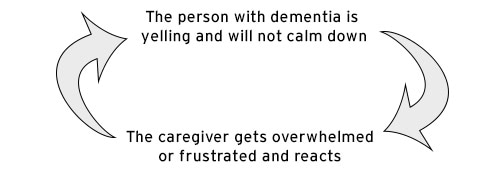
The Baycrest Quick-Response Caregiver Tool tries to prevent this cycle from developing.
The behaviour of the person living with dementia can be very difficult to understand. Caregivers might ask, why is the person yelling? Is there some need that isn’t being met? Do they want something? The person living with dementia may not be able to explain why they are yelling. The key is for the caregiver to not react immediately.
The Baycrest Quick-Response Caregiver Tool includes five steps that caregivers can follow. This can help caregivers better understand the person with dementia and learn how to deal with the situation more effectively.
The Baycrest Quick-Response Caregiver Tool is found in full below. You can also download the tool or access it in seven different languages.
Baycrest Quick-Response Caregiver Tool
The tool uses the acronym CARER to help remind caregivers of the following five steps.
Learn more
We are all human and have feelings. We all react to situations and to other people’s feelings. The first step is to take a moment to try to calm down so that we avoid making the situation worse. Of course, this can be hard to do. The caregiver may step back, take some deep breaths, or use some positive self-talk to calm down and then take the next steps. Most of us can tell when we are getting angry or frustrated. The trick is to catch yourself right away and then step away.
This step helps the caregiver remember that the person living with dementia is distressed. It is a matter of slowing down and taking a break before reacting. It is a time to remind oneself that the person living with dementia has an illness – their brain is not working properly, and it is not their fault. The behaviours are not intentional. The person may have a very hard time describing what they need. The caregiver must remember that this person has a brain illness and can’t explain why they are distressed.
Now that the caregiver has calmed down and taken a short break to recall that the person has an illness that affects their brain, it is time for some self-talk. This is called reflection. The caregiver will ask himself or herself some questions:
- What am I feeling? (for example, angry, frustrated, worried or sad)
- Why do I feel this way?
This is a very important step. Caregivers need to think about their own emotional reaction to what is going on. This involves reflecting on how one’s feelings and responses can affect the person living with dementia. By trying to answer these two questions, the caregiver can begin to think through the situation and then consider how to best respond.
Empathy is when someone tries to understand what the other person is feeling. Now it is time to consider what the person living with dementia is feeling. Some more self-talk:
- What is the other person feeling?
- Why is the other person feeling this way?
Now that the caregiver has become calm (step 1), remembered that the behaviours are unintentional symptoms of an illness (step 2), and considered his or her own feelings (step 3), and the feelings of the person living with dementia (step 4), the caregiver can try to understand what the person living with dementia wants or needs and respond in a helpful, compassionate way.
The caregiver can now try to understand what the person living with dementia wants or needs and respond in a more supportive and empathetic manner.