Research Themes
With a primary focus on aging and brain health, including Alzheimer’s and related dementias, research at Baycrest’s Rotman Research Institute and across the Baycrest campus promotes effective care and improved quality of life for older adults through research into age- and disease-related behavioural and neural changes.
The following research themes guide our investigations and give them shape and focus.
Our themes
Scientists at the Rotman Research Institute investigate fundamental questions about memory, aging and the neuroscience of cognition.
How does the brain think? That is the question addressed by cognitive neuroscience — a combination of psychology and neuroscience that aims to identify how the brain gives rise to mental activity. Scientists at the Rotman Research Institute examine how the human brain is able to comprehend, reason, solve problems and remember events of our lives. In particular, since its founding in 1990, the Rotman Research Institute has been dedicated to understanding how the brain makes memory and thought possible. To answer this question, we need tools that allow us to peer inside the brain.
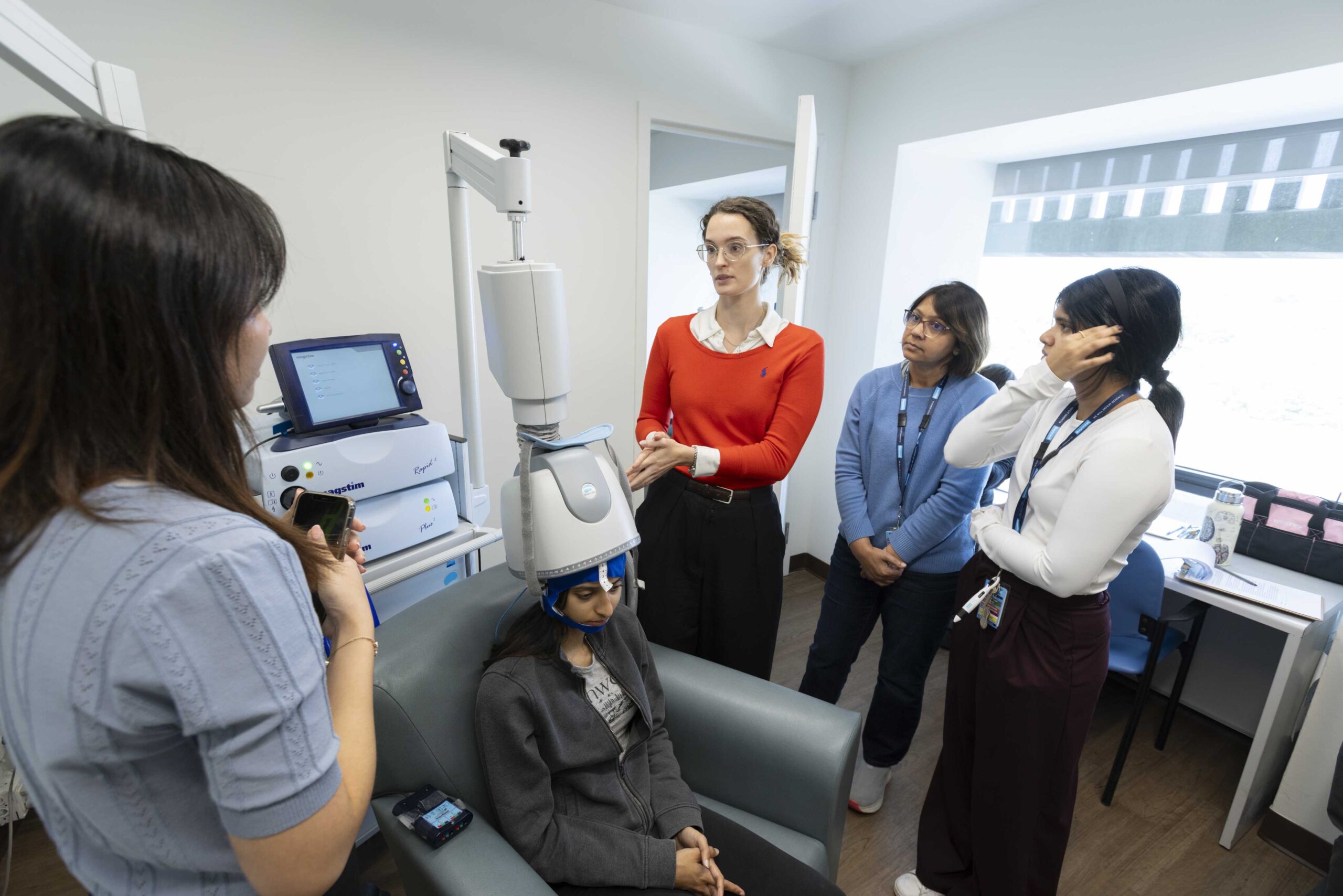
We have a full suite of state-of-the-art tools to carry out world-class cognitive neuroscience and make fascinating and critical new discoveries about how the brain works. Among other devices, we have magnetic resonance imaging (MRI) to observe the brain’s structure and function, electroencephalography (EEG) and magnetoencephalography (MEG) to measure the brain’s electrical activity and transcranial magnetic stimulation (TMS) to safely stimulate the brain and see how it can improve or rehabilitate memory and cognition.
Understanding how the brain thinks and remembers is fundamental to critical research involving healthy aging and neurodegenerative disease. If we can better understand the properties, functions and mechanisms of the brain, we can better see how and why it encounters challenges or dysfunction, and how to best prevent this from happening.
Older adults now outnumber children in Canada and that gap will continue to grow.
All our memories, the record of our lives, and the skills and knowledge we have acquired over a lifetime are wound up in the brain’s cells, synapses, connections and tissues. A healthy brain is capable of regeneration, adaptation and learning. In the best circumstances, this remains true decades after the appearance of the first strand of gray hair. However, just like the heart, lungs and gut, the brain needs a healthy environment to thrive.
Scientists at the Rotman Research Institute investigate how the brain changes with age, and how it evolves and adapts to best preserve its core functions. One of our major goals is to understand how we can optimize our lives to create the best possible conditions for the brain to thrive as it ages. To that end, we study how factors such as music, art, physical activity, environment and other influences may help maintain brain function as we get older. We also investigate the anatomy and function of the brain itself to see which parts are most susceptible to aging.
We conduct research to help current and future generations navigate the journey of aging — one that may include conditions such as Alzheimer’s disease and other dementias — along the smoothest and most optimal course. Our work aims to delay or prevent dementia, to treat it through behavioural and pharmacological interventions, and to lessen its impact on the lives of patients and their caregivers. We achieve this through foundational and translational science.
By furthering our understanding of aging and the human brain, foundational research at the Rotman Research Institute helps us identify differences in cognition between those who develop dementia and those who do not.
Translating this knowledge, the Anne & Allan Bank Centre for Clinical Research Trials at Baycrest serves as a hub for the development and validation of emerging diagnostic tools and treatments for age-related neurodegenerative diseases, turning scientific discoveries into real-world applications to benefit patients.
Baycrest is also the national scientific headquarters for the Canadian Consortium on Neurodegeneration in Aging, which enhances collaboration and maximizes the impact of dementia research nationwide.
The Rotman Research Institute has a long history of studying the brain as a network of connections that is best understood by looking at how its parts operate together. By focusing on the brain as an “orchestra” rather than as a collection of individual “players,” we are better able to model its working flow, to see in real-time how it conducts itself and how it manages to be more than a sum of its parts. Neuroinformatics allows us to do these things by combining neuroscience and powerful information processing.
Through our commitment to open science, we extend, magnify and multiply the reach and influence of our work far beyond our own walls. By making data, software and computational tools open and accessible to the scientific community at large, we turn every discovery into a global resource — fueling new breakthroughs, accelerating innovation and connecting scientists across continents.
A single study conducted at Baycrest today can inform and inspire new research across the globe — instantly. Today, research generated at Rotman Research Institute can spark insights in labs from Thailand to New Zealand to Israel within minutes, expanding the reach of our science beyond borders.