Continuing Education
At Baycrest, learning never stops. We believe everyone – including staff, learners and clients – benefits from continually learning new ideas and up-to-date practices.
Tele-Education
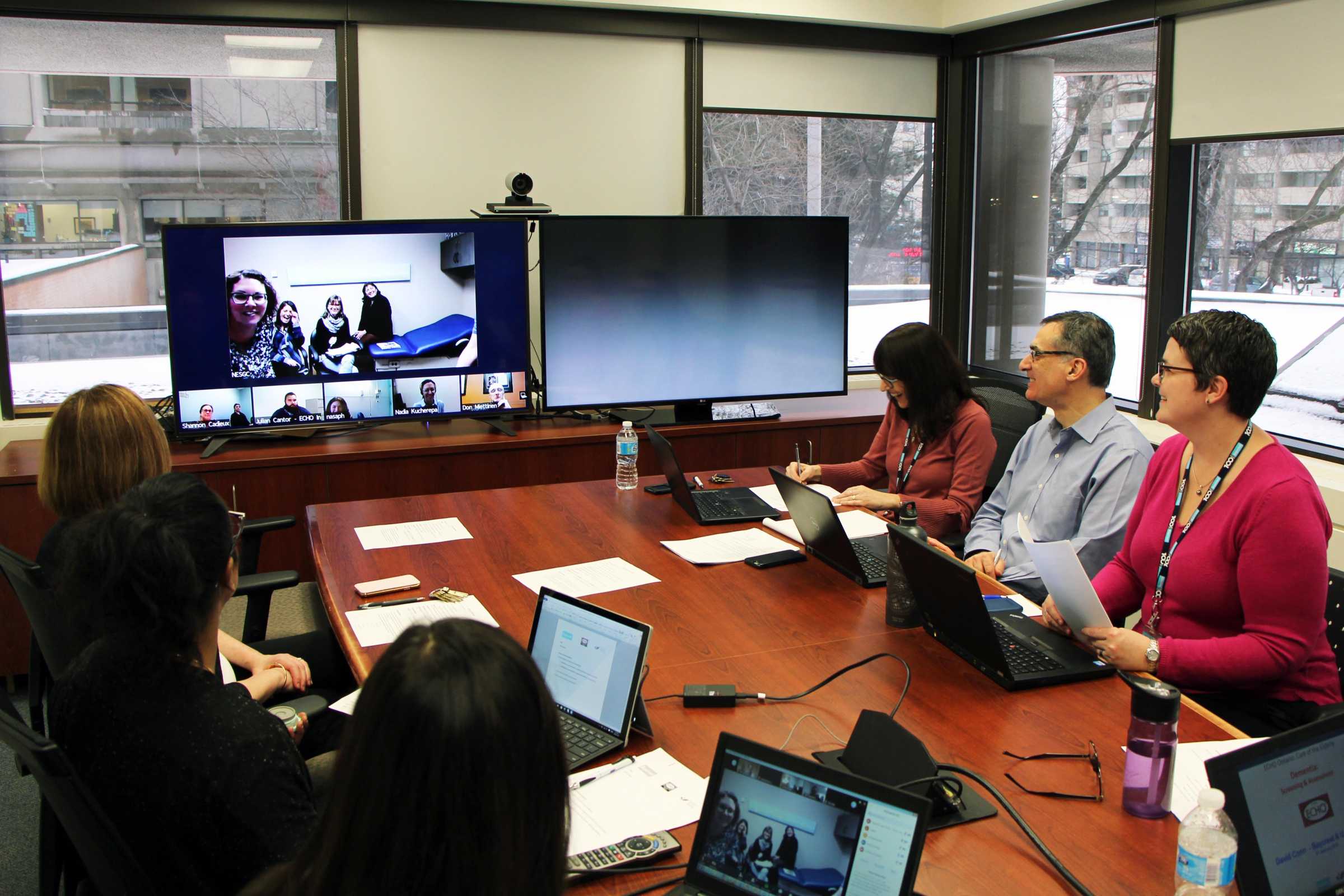
The Baycrest Telehealth program produces comprehensive tele-education rounds. These rounds are an excellent opportunity for physicians, nurses and allied health-care professionals to share best practices, discuss interesting cases and develop relationships across the health-care community.
Specialists in behavioural neurology, geriatric mental health, geriatric medicine and addictions use tele-education to share case presentations and provide peer support. Our international colleagues reciprocally share their expertise and best practices with us.
Examples of rounds include the following:
- International Behavioural Neurology
- Geriatric Medicine
- International Geriatric Mental Health (I-GeMH)
- Geriatric Addictions
- Behavioural Support
- Centre for Education
- Department of Psychiatry
We also provide specialist consultations in geriatric psychiatry, pain management, palliative care and neurology to patients and families. These consultations are especially important to remote areas such as Northern Ontario where a subspecialist is not available.
For further details on tele-education rounds and how to participate please contact Agnes Cheng Tsallis – [email protected]
Workshops
Many of our workshops are also open to health-care professionals outside of Baycrest.
This train-the-trainer workshop teaches clinicians and learners who work with older adults how to deliver memory-based interventions. Drawing on content from Baycrest’s Memory and Aging Program® for older adults with normal age-related changes, this workshop covers:
- Age-related memory changes
- Health and lifestyle factors that affect memory
- Evidence-based protocols to promote brain health
- Hands-on practice with training others in the use of memory strategies
- The benefits of memory interventions for older adults
- Common challenges to delivering group memory interventions
Learn from experts who have 35 years of collective experience developing, implementing and evaluating memory interventions for older adults.
Facilitators
Dr. Susan Vandermorris, PhD, CPsych, Clinical Neuropsychologist
Dr. Angela Troyer, PhD, CPsych, Interprofessional Practice Chief
Upcoming dates
No current upcoming dates. Please check back again at a later date.
Learn more about the Memory and Aging Program®.
This train-the-trainer workshop teaches clinicians and learners who work with older adults how to deliver Learning the Ropes for Living with MCI®, an evidence-based program for people living with mild cognitive impairment (MCI) and their family members.
Drawing on content from the program, the workshop focuses on promoting cognitive health, building memory strategies and supporting adaptive coping in both individuals with MCI and their close relatives.
This workshop covers:
- How MCI differs from normal aging and dementia and how cognitive processes are affected
- Practical memory and lifestyle strategies to promoted brain health and well-being
- Hands-on experience teaching memory and cognitive strategies to others
- How to engage participants in group interventions that support behavioural change and positive cognitive health outcomes
- The impact of MCI on individuals and their close relatives, including approaches to foster coping and resilience
- How to adapt and flexibly deliver the program to best meet participants’ needs
Learn from experts with clinical experience, research expertise and practical skills in delivering memory interventions for older adults.
Facilitators
Dr. Keera Fishman, Ph.D., C.Psych., Clinical Neuropsychologist
Dr. Matthew McPhee, Ph.D., C.Psych., Neuropsychologist
Jessie Lin, MSW, RSW, Social Worker
Upcoming dates
No events currently scheduled. Please check back later.
Learn more about Learning the Ropes for Living with MCI®
This train-the-trainer workshop provides the latest clinical-scientific information on the assessment of executive functions and how to deliver Goal Management Training® (GMT). GMT is a leading evidence-based intervention for individuals experiencing challenges with concentration, planning and task completion.
Offered through the Rotman Research Institute, this workshop is grounded in neuroscience theory, but the emphasis will be applied with the use of clinical cases. It covers:
- The neuropsychology and cognitive neuroscience of executive functions
- Psychological and neuroanatomical background
- Neuroimaging findings
- Diagnostic considerations
- Clinical assessment
- Conditions causing diffuse brain impairment
- Access to new electronic resources and protocol adaptations
Learn from a leading expert in executive and prefrontal function and cognitive neurorehabilitation.
Facilitator
Dr. Brian Levine, Ph.D., C.Psych., ABPP-cn, Senior Scientist, Rotman Research Institute; Professor, University of Toronto
Continuing education (CE) credits
Canadian Psychological Association: Six CE credits for psychologists
Medical Psychotherapy Association of Canada: Six hours of group CE credits and one hour of CCI credits
Get started on your GMT training.
This train-the-trainer workshop is designed for clinicians and students working with individuals experiencing stable moderate-to-severe memory impairment that prevents them from learning and utilizing internal memory strategies. The focus of this memory intervention method is to convey step-based skills to individuals with significant learning and memory difficulties and then apply those skills in strategic ways to compensate for functional memory in daily life. Content and examples will be drawn from Baycrest’s Memory Link Program, which provides memory rehabilitation services to individuals with acquired brain injury.
During this workshop, you will:
- Review background memory theory about normal memory and amnesia
- Learn about evidence-based approaches to memory rehab
- Understand evidence for skill learning in memory-impaired adults
- Learn how to train new step-based skills in adults with moderate-to-severe memory impairment using the Memory Link Method
- Learn how to determine appropriateness for using the Memory Link method and adaptations to tailor treatment to specific client types
- Learn how to adapt the Memory Link Method to be applied virtually (information not contained in the manual)
- Appreciate and learn to manage common challenges to delivering individual memory intervention for moderate-to-severe impairments
Learn from an expert in neuropsychology and memory intervention for people with significant explicit memory dysfunction.
Facilitator
Dr. Brandon Vasquez, PhD, CPsych, Psychologist in Neuropsychology and Cognitive Health, Baycrest; Assistant Professor, University of Toronto
Registration
For more information, contact [email protected].
The Canadian Coalition for Seniors’ Mental Health (CCSMH) is pleased to let you know that free, asynchronous, accredited eLearning modules on Cannabis and Older Adults are now available.
The target audiences are physicians, nurse practitioners, other health-care providers and health-care students. Asynchronous learning allows you to pick the best times for you to complete the modules.
Examples of topics include:
- Evidence for cannabis as treatment
- Medico-legal considerations
- How to talk to older adults about cannabis
- Drug interactions
- Adverse events
- Safer cannabis use
- Developing a treatment plan
Continuing education (CE) credits
Each eLearning module is individually accredited (MOC, MainPro+) so you can do one, a few or all of them for up to a total of 6.75 hours/credits.
Registration
For more information and to register, visit the CCSMH.
E-Learning for Baycrest staff
The following information will help Baycrest staff access and navigate the Learning Management System (LMS). Note that you can access the LMS from any browser or device connected to the internet on or off the Baycrest campus.
If you have a Baycrest email address, download this self-training guide (PDF).
If you do not have a Baycrest email address, download this self-training guide (PDF).
All staff can learn more about:
- Logging into the LMS with a Baycrest email address (Download PDF). Watch Video.
- Logging in as an employee without a Baycrest email (Download PDF). Watch Video.
- Finding your mandatory courses (Download PDF). Watch Video.
- Starting your mandatory courses (Download PDF). Watch Video.
- Printing a Certificate of Completion (Download PDF). Watch Video.
- Seeing which mandatory courses you have already completed Download PDF. Watch Video.
- Searching for a course (Download PDF). Watch Video.
- Registering for a classroom course (Download PDF). Watch Video.
- Allowing pop-ups in your web browser (Download PDF). Watch Video.
Managers and supervisors can learn more about:
- Finding out how your team is doing Download PDF. Watch video https://youtu.be/IJ1hP9bCVgQ
- Seeing which courses your staff still need to complete Download PDF. Watch video https://youtu.be/ExWQVh9rQiA
Facilitators and instructors can request a new classroom be created in the LMS by emailing this request form (DOCX) to [email protected].
To request a new eLearning module, please complete this request form (DOCX) and send it to [email protected].
Supporting documents
- Storyboard template
- Action mapping guide
- E-learning module QA checklist
- E-learning module evaluation
Contact your e-learning team with any questions or concerns at [email protected].
Location
Email: [email protected]